
Site Preparation & Grading Mesa AZ

Professional Site Preparation & Grading for Residential & Commercial Projects

Complete Site Preparation Services in Mesa, Arizona

Site preparation transforms raw land into construction-ready property by clearing, grading, excavating, installing utilities, compacting, and installing drainage.

Proper site prep prevents foundation issues, drainage problems, structural settlement, and costly future repairs.

We serve residential new construction, commercial building pads, subdivision development, and site additions throughout Mesa, Gilbert, Chandler, Tempe, Queen Creek, and the East Valley.

Residential Site Preparation & Grading Services in Mesa

Specialized site preparation for single-family homes, custom builds, residential additions, and ADU development throughout Mesa’s planned communities and custom home neighborhoods.

New Home Construction

Complete site preparation for single-family residential builds

Custom Home Sites

Raw land transformation for custom residential projects

Home Additions

Foundation excavation and site prep for additions

ADU/Casita Development

Backyard accessory dwelling unit site preparation

Subdivision Lot Grading

Professional grading for residential development lots

Landscaping Prep

Driveway and landscape area preparation

Commercial Site Preparation & Grading Services in Mesa

Large-scale site development for commercial building pads, retail centers, office complexes, industrial sites, and multi-tenant developments throughout Mesa’s commercial corridors.

Retail Center Development

Shopping centers, strip malls, and retail complexes

Office & Medical Facilities

Professional office buildings and healthcare sites

Industrial & Distribution

Warehouse and distribution center site prep

Restaurant Pad Preparation

Fast-food and restaurant building sites

Multi-Tenant Commercial

Mixed-use and multi-tenant developments

Parking Lot Grading

Extensive parking and access road preparation

Professional Site Grading & Compaction Testing

Establishing precise elevations, slopes, and contours per engineering plans for proper drainage, structural stability, erosion prevention, and foundation support.

Rough Grading

  • Initial earthmoving and shaping operations
  • Cut and fill to achieve design elevations
  • Establishing major drainage patterns
  • Creating building pads and parking areas
  • Mass earth moving with dozers and scrapers
  • Timeline: 2-6 weeks, depending on site size

Fine Grading & Laser Leveling

  • Precision finish grading to final elevations (±0.1 feet tolerance)
  • Laser-guided grading equipment with GPS technology
  • Creating smooth, stable construction-ready surfaces
  • Final drainage verification and adjustment
  • Paving sub-base preparation for commercial projects
  • Landscape area final grading and contouring
  • Timeline: 1-3 weeks after rough grading

Soil Compaction & Testing

Why Compaction is Critical

Prevents settlement, foundation cracking, and pavement failure through proper soil density

Standard Proctor Testing

Residential applications requiring 90-95% density for foundation support

Modified Proctor Testing

Commercial and heavy load applications requiring 95%+ density for structural integrity

Nuclear Density Gauge

Quick, accurate field testing providing immediate density readings for verification

Certified Technicians

In-house testing equipment and certified professionals for quality assurance

Mesa Requirements

Compaction testing is often required for commercial projects and for residential foundations

Our Professional 6-Phase Site Preparation Process

Complete site preparation from initial assessment through final inspection, with every phase coordinated for efficiency and quality.

Site Assessment & Planning

Complete site evaluation and project planning

  • Initial site visit and topographic survey review
  • Soil analysis and geotechnical report review (commercial)
  • Utility location coordination via Arizona 811 Blue Stake
  • Engineering plan review (grading, drainage, utilities)
  • Mesa permit research (At-Risk Grading Permit options)
  • Environmental considerations and access assessment
  • Detailed written estimate with scope and timeline
  • No-obligation estimate process

Permitting & Pre-Construction

Complete permit coordination and approvals

  • Mesa Building Safety grading permit application
  • At-Risk Grading Permit (allows work before the construction permit)
  • ADEQ Notice of Intent for sites disturbing 1+ acre
  • Maricopa County Rule 310 Dust Control Compliance Plan
  • Utility company coordination (SRP, Southwest Gas, Mesa Water)
  • Erosion control and stormwater pollution prevention plan
  • HOA approval in planned communities
  • Final pre-construction meeting with all stakeholders

Site Clearing & Demolition

Complete site preparation and clearing

  • Erosion control installation (silt fencing, inlet protection)
  • Dust suppression setup with water trucks and misting
  • Existing structure demolition if required
  • Desert vegetation clearing (mesquite, palo verde, cacti)
  • Protected species handling per environmental regulations
  • Debris removal and hauling to licensed facilities
  • Underground obstacle removal (old foundations, pipes, tanks)
  • Site access and staging area establishment

Rough Grading & Excavation

Major earthmoving and site shaping

  • Cut and fill operations to achieve design elevations
  • Building pad creation at engineered elevations
  • Caliche layer breaking with hydraulic breakers (Mesa-specific)
  • Utility trench excavation (water, sewer, gas, electric)
  • Storm drainage infrastructure (retention/detention basins)
  • GPS-guided equipment for precise elevation control
  • Continuous dust control during all earth movement
  • Balance cut/fill to minimize import/export costs

Utility Installation & Fine Grading

Underground utilities and precision grading

  • Underground utility installation (water, sewer, gas, electric)
  • Utility coordination and connection appointments
  • Pressure testing of water and gas lines
  • Proper backfill and compaction of all trenches
  • Laser-guided fine grading within 0.1 feet tolerance
  • Final drainage slopes (minimum 2% away from buildings)
  • Systematic soil compaction to the required density
  • Mesa inspection coordination before backfill

Testing, Inspection & Final Cleanup

Quality verification and project completion
  • Nuclear density gauge compaction testing
  • Density reports for the engineer and permit approval
  • Final grading verification and survey confirmation
  • Drainage flow testing (no ponding near buildings)
  • Mesa Building Safety final inspection and sign-off
  • Utility company final inspections
  • Site cleanup and excess material removal
  • Project documentation delivery and closeout meeting
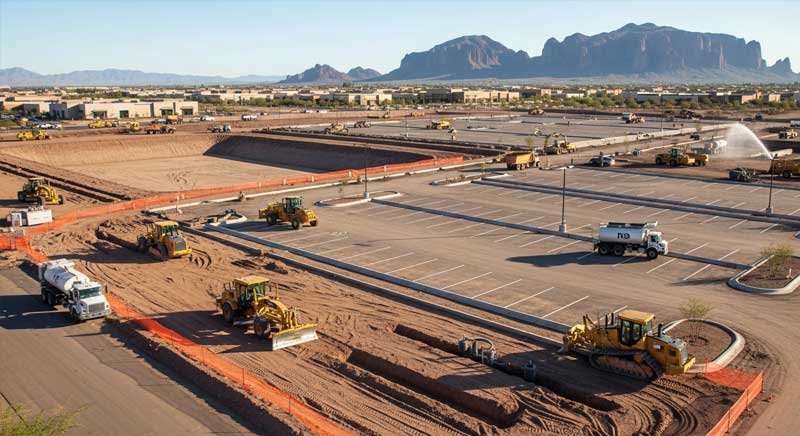
Construction vehicles and equipment are working on a large parking lot site, with dirt being moved and areas sectioned off by orange fencing. Mountains are visible in the background.

What Makes Site Preparation in Mesa Unique?

  • Caliche Soil Conditions
    Mesa’s hardened calcium carbonate layer requires specialized hydraulic breakers and equipment for excavation
  • Dust Control Rule 310
    Maricopa County compliance is mandatory with continuous water suppression and site management
  • Monsoon Drainage
    Critical stormwater systems for intense Arizona rainfall patterns during the July-September season
  • Desert Environment
    Extreme heat, unique soil composition, and native vegetation requiring specialized handling
Get a Free Quote

Factors That Affect Site Preparation & Grading Costs in Mesa

Site preparation and grading costs vary significantly based on your specific Mesa property conditions and project requirements.

While DirtFX provides detailed written estimates after an on-site assessment, understanding the key cost factors helps you plan your project budget effectively.

Every site is unique, and we believe in transparent communication about the factors that influence pricing.

Site Size & Scope

Total acreage, number of building pads, parking areas, and roadways. Larger projects have economies of scale but require more equipment and time. Residential lots (6,000 sq ft vs 1+ acre custom sites) and commercial multi-acre developments vary significantly.

Existing Site Conditions

Topography (flat vs. sloped terrain), vegetation density, existing structures requiring demolition, underground obstacles, and the presence of Mesa’s caliche layer significantly impact excavation time and equipment costs. Soil type affects grading and compaction requirements.

Cut & Fill Requirements

Amount of earth movement required, balance of cut and fill, excavation depth for foundations, off-haul costs for excess material, import costs for additional fill, and haul distance to disposal or borrow sites. Balanced sites are more cost-effective.

Utility Infrastructure Needs

Distance to utility connections (water main, sewer line, gas, electric), number of utilities requiring installation, trench depth and length, coordination complexity with multiple providers, and special requirements like fire hydrants. Joint trenching can reduce costs.

Drainage & Stormwater Management

Retention basin volume requirements, detention basin capacity, storm drain piping length and size, erosion control complexity, and Mesa-specific monsoon drainage intensity. Soil permeability affects infiltration design and system sizing.

Engineering & Testing Requirements

Geotechnical soil reports for commercial projects, civil engineering plans for grading and drainage, compaction testing frequency and locations, inspection services during construction, as-built surveys, and professional engineer stamps and certifications.

Mesa Permit & Regulatory Costs

Mesa grading permits vary by project type, commercial site plan review based on acreage, ADEQ Notice of Intent for sites disturbing 1+ acre, Maricopa County Dust Control permit compliance plan, environmental permits for protected species, and inspection fees.

Project Timeline & Scheduling

Standard vs expedited timelines, seasonal considerations (summer heat work schedules, monsoon season weather delays), permit processing time, utility company scheduling (sometimes a 2-4 week wait), coordination with other contractors, and Mesa Building Safety inspection booking.

Access & Staging Constraints

Site access difficulty (narrow roads, gated communities, tight streets), equipment delivery challenges, material storage space availability, neighbor impact mitigation, HOA restrictions (hours, equipment size, noise), and restoration of access routes after completion.

Specialized Requirements

Protected vegetation handling (saguaro relocation, mesquite preservation), archaeology monitoring if required, high-intensity dust control for sensitive areas, traffic control near public roads, special equipment for unique site challenges, and extended mobilization for remote locations.

Transparent Pricing

DirtFX provides comprehensive written estimates that itemize all costs specific to your Mesa property. After our free on-site assessment, you’ll receive a detailed breakdown covering labor, equipment, materials, permits, testing, and any special requirements. We pride ourselves on transparent pricing with no hidden fees or surprise charges. Contact us at 480-571-1046 for your free site preparation and grading estimate.

Site Preparation & Grading Questions Mesa Property Owners Ask

Everything you need to know about professional site preparation and grading services in Mesa, Arizona

Site preparation is a comprehensive term covering all work to prepare raw land for construction, including land clearing, demolition, excavation, grading, utility installation, drainage, and compaction. Site grading is a specific component of site preparation that establishes precise elevations and slopes. Grading includes rough grading (initial earthmoving) and fine grading (final elevations). In Mesa, site prep also includes caliche removal, dust control setup, and erosion control installation. Complete site preparation transforms unusable raw land into construction-ready property. DirtFX provides full-service site preparation, including all grading operations, typically taking weeks of work with grading as the final 2-4 week phase. Mesa requires grading permits for both rough and fine grading operations.

Residential projects typically take 4-8 weeks from permit to final inspection, while commercial projects usually require 8-20 weeks, depending on size and complexity. The timeline breaks down into phases: permitting and planning (2-4 weeks), site clearing and demolition (1-2 weeks), rough grading and excavation (2-6 weeks), utility installation (2-4 weeks), fine grading and compaction (1-3 weeks), and testing/final inspection (1 week). Factors affecting the timeline include site size and topography, utility connection distances, Mesa permit processing time (currently 2-4 weeks), weather delays (rare except during the monsoon season), and soil conditions, including caliche depth. A simple example: a level 1-acre residential lot with nearby utilities takes 4-6 weeks. A complex commercial example: a 5-acre site with extensive drainage requires 12-16 weeks. DirtFX’s established Mesa relationships help speed permit approvals.

Yes, Mesa Building Safety requires grading permits for most earthwork projects. Permit types include the At-Risk Grading Permit (a unique Mesa option allowing grading before a full construction permit is issued) and the standard grading permit (part of the overall construction permit package). At-Risk Grading Permit requirements include approved grading and drainage plans by a registered civil engineer, an ADEQ Notice of Intent (NOI) if disturbing 1+ acre, proof of property ownership or authorization, a Mesa Building Safety application and fees, and a dust control compliance plan. Benefits include starting site work earlier in the construction timeline, securing the building pad before architectural plans are finalized, and taking advantage of favorable weather or contractor availability. Commercial projects always require permits with more extensive engineering, environmental compliance, and utility coordination. Mesa permit fees vary by project scope and acreage. DirtFX handles all permit coordination, application preparation, plan submission, and inspection scheduling for your project.

Caliche is a hardened calcium carbonate layer formed over thousands of years, common throughout Mesa at depths of 6-36 inches below the surface. It’s an impermeable layer that standard equipment can’t penetrate efficiently. Caliche must be addressed because it blocks foundation excavation, prevents proper drainage and infiltration, must be broken through for utility trenches, can cause differential settlement if partially removed, and engineers often require complete removal from building pad areas. DirtFX’s caliche solutions include hydraulic rock breakers (powerful impact hammers mounted on excavators with 1,500+ ft-lbs force), ripping with heavy dozer ripper teeth to fracture caliche before removal, backhoe with rock teeth for smaller areas and trenching, and proper equipment sizing to match caliche depth and hardness. Our removal process identifies caliche depth during site assessment, breaks it into manageable pieces, removes or crushes it for use as base material (if the engineer approves), and properly compacts the underlying native soil. Mesa caliche is most common south of US-60 and west of Power Road, but it is found throughout the area. Caliche removal adds time and equipment costs, which are factored into estimates after the site assessment. Extensive caliche can add 1-2 weeks to the rough grading phase. DirtFX has 10 years of experience working with Mesa caliche, with proper equipment always on hand and no surprises—caliche assessment included during the free site evaluation.

Costs vary significantly based on multiple factors, including site size, soil conditions, topography, utility distances, and drainage requirements. Typical residential projects range from basic house pads on level lots with nearby utilities to custom home sites on sloped terrain with distant utilities, with residential subdivision lots in the mid-range per lot. What’s included in residential site prep: land clearing and vegetation removal, rough grading to establish building pad, foundation excavation, utility trenching (water, sewer, gas, electric), fine grading with laser leveling, soil compaction to specifications, and drainage installation (swales, proper slopes). Not typically included: utility connection fees to providers, landscape materials, or paving. Mesa-specific cost factors include caliche removal, which adds time and equipment costs; HOA requirements, which add coordination time; and dust control equipment and monitoring—some homeowners finance site prep as part of their construction loan. DirtFX provides detailed written estimates after an on-site assessment, itemizing all costs. Contact 480-571-1046 for your free residential site prep estimate.

Yes, DirtFX specializes in backyard ADU (Accessory Dwelling Unit) and casita site preparation. Our ADU/casita site prep services include small-scale excavation for foundations (typically 500-1,200 sq ft), backyard access coordination (through side gates, alley access), utility trenching from main house connections, minimal disruption to existing landscaping, and compact equipment for tight spaces. Mesa ADU considerations include setback requirements from property lines, drainage that must not impact neighboring properties, separate utility meters, often required, HOA approval in planned communities, and Mesa Building Safety permits. Typical ADU site prep timeline is 2-4 weeks for most backyard projects. Our equipment access includes mini excavators that fit through standard 4-6 foot side gates. We coordinate with the main house contractors, plumbers, and electricians. Mesa ADU growth is increasing for multigenerational housing and rental income properties. DirtFX has completed numerous Mesa backyard ADU site preparation projects. We offer free consultation to assess your property and provide detailed feasibility and cost estimates.

Proper drainage is critical for Mesa homes to prevent foundation damage, flooding, and erosion, especially during the Arizona monsoon season’s intense rainfall (July-September). Residential drainage methods include positive drainage slopes grading away from foundation (minimum 2% slope for first 10 feet), swales (shallow channels directing water to discharge points), French drains (perforated pipe in gravel trenches for subsurface drainage), area drains (catch basins in low spots connecting to drain pipes), and proper yard drainage contouring to prevent water pooling. Mesa-specific drainage considerations include desert soil with variable permeability (sandy areas vs. clay pockets), a caliche layer that can impede water infiltration, neighboring property considerations (can’t drain onto a neighbor’s lot), and HOA drainage requirements in planned communities. Complex residential sites may require drainage plans by civil engineers. DirtFX’s approach establishes proper foundation slopes during grading, installs drainage systems per engineer specifications, tests water flow before final inspection, and coordinates with landscape contractors for final grading. Homeowners should maintain swales clear, keep area drains clean, and ensure proper roof gutters.

Commercial site preparation differs significantly in scale and complexity. Commercial sites are typically multi-acre developments versus residential single lots. Key differences include engineering requirements (professional civil engineer involved throughout commercial projects vs basic requirements for residential), compaction standards (95%+ Modified Proctor commercial vs 90-95% Standard Proctor residential), utility infrastructure (larger water mains, sewer lines, electrical services, sometimes fire protection systems vs standard residential utilities), parking lots (extensive paving preparation with specific sub-base requirements), storm drainage (retention or detention basins, underground storm drains, complex calculations vs simple residential swales), timeline (8-20 weeks commercial vs 4-8 weeks residential), permits (more extensive review, higher fees, ADEQ involvement for 1+ acre sites vs simpler residential licenses), and testing (more frequent compaction testing, material testing, ongoing inspections). Commercial equipment includes larger dozers, articulated haul trucks, heavy-duty compactors, and paving machines. Coordination involves multiple contractors, utility companies, engineers, inspectors, and landlords/tenants. Mesa commercial zones include the Main Street corridor, the Superstition Springs area, and the East Valley business districts. Commercial work requires higher ROC licensing classifications, and developers often require performance and payment bonds. DirtFX is licensed for commercial work, experienced with Mesa commercial sites, and maintains a modern equipment fleet.

Yes, DirtFX manages complete utility coordination for Mesa commercial sites. Utility companies we work with include SRP (Salt River Project) for electric power service, transformer placement, and metering; Southwest Gas for natural gas lines, meter locations, and pressure requirements; City of Mesa Water for water main connections, meter sizing, and fire hydrants; Cox Communications for cable/internet conduit and infrastructure; CenturyLink for telecommunications fiber and copper lines; and sometimes private utilities like HOA water systems or private sewer. Our coordination process includes early notification to all utility providers during the design phase, scheduling utility line location (Arizona 811 Blue Stake), coordinating connection point locations with civil engineers, trenching to install conduits and pipes to utility specifications, scheduling utility company installations and inspections, coordinating timing with overall project schedule, and timing final connections with building occupancy. Joint trenching, when feasible, places multiple utilities in a single trench to reduce costs and site disruption. Utility timeline challenges include the need for 4-8 weeks’ advance notice for new services. DirtFX’s advantage lies in its established relationships with Mesa utility providers and its understanding of their processes and requirements. We handle all communication, scheduling, inspections, documentation, and connection verification.

Mesa commercial permits are extensive and require professional coordination. Required permits include commercial grading permit (part of overall site development approval), site development plan approval (Mesa Development Services review of civil engineering plans), building permits for structures (separate from site work but coordinated), ADEQ Notice of Intent (NOI) required if disturbing 1+ acre or more, Stormwater Pollution Prevention Plan (SWPPP) for sites with ADEQ NOI, Maricopa County Dust Control permit for Rule 310 compliance, right-of-way permits if work impacts public streets or sidewalks, and utility permits from each utility company for connections. Permit costs include site plan review, commercial construction permit, ADEQ NOI, and various utility connection permits and fees. The processing timeline includes Mesa site development plan review (4-8 weeks for initial review), multiple review cycles common for complex commercial projects, ADEQ NOI (2 weeks processing), and full approval to start grading, which often takes 6-12 weeks total. Required documentation includes civil engineering plans (grading, drainage, utilities), traffic study for larger developments, environmental reports if needed, geotechnical soil reports, landscape plans, and photometric lighting plans. DirtFX coordinates with civil engineers and handles grading-related permit submittals and inspections. Contact Mesa Development Services at (480) 644-2211.

DirtFX has specialized expertise and equipment for Mesa’s challenging caliche conditions. We use hydraulic rock breakers (powerful impact hammers mounted on excavators with 1,500+ ft-lbs force), ripping with heavy dozer ripper teeth to fracture caliche before removal, backhoe with rock teeth for smaller areas and trenching through caliche, and proper equipment sizing to match caliche depth and hardness. Our caliche removal process identifies caliche depth during site assessment, breaks it into manageable pieces, removes or crushes it for use as base material (if the engineer approves), and properly compacts the underlying native soil. Mesa caliche is most common south of US-60 and west of Power Road, but it is found throughout Mesa at varying depths. Cost impact: caliche removal adds time and equipment costs, which are factored into estimates after site assessment. Timeline impact: extensive caliche can add 1-2 weeks to the rough grading phase. DirtFX has 10 years of experience working with Mesa caliche and always has proper equipment on hand. No surprises—caliche assessment is done during our free site evaluation, so you know exactly what to expect.

Dust control is a critical requirement under Maricopa County Rule 310, which mandates dust control for all construction sites. It’s especially important in Mesa’s desert environment with very dry, fine soils that are easily airborne, for neighbor consideration and property protection, health concerns (respirable dust, Valley Fever prevention), regulatory compliance (fines for violations), and particularly during dusty summer months (May-September). DirtFX’s dust control methods include water trucks on-site throughout projects with continuous misting during earthmoving, water application on roads, exposed soil, active work areas and haul routes, soil stabilizers (chemical treatments) for long-term exposed areas, reduced vehicle speeds on unpaved areas to reduce dust generation, gravel base on haul roads and the high-traffic regions, wind fencing (temporary barriers) when needed for particularly dusty conditions, wet methods with water application before and during grading, excavation and loading, and cover materials (tarps or mulch) for stockpiles and inactive areas. We conduct daily inspections and adjust methods based on weather and soil conditions. Mesa afternoon winds require increased dust-control efforts when winds pick up (typically in the afternoons). We provide neighbor communication, notifying adjacent properties and providing contact for concerns. Compliance documentation maintains records of dust control activities for Mesa inspections. Dust control is included in DirtFX site preparation pricing at no additional charge. Mesa violations for failure to control dust can result in work stoppages and fines—we ensure full compliance throughout your project.

Still have questions about your demolition project?

Why Mesa Property Owners Choose DirtFX Excavation

Professional excavation backed by experience, expertise, and local knowledge

10+ Years Mesa-Specific Experience

Decade of demolition expertise serving Mesa, Gilbert, and East Valley property owners. We understand local codes, soil conditions, and permit requirements.

Fully Licensed & Insured

ROC licensed contractor with comprehensive general liability and workers compensation insurance protecting your property and our crews.

Specialized Caliche Equipment

Heavy-duty hydraulic breakers designed specifically for Arizona’s hard caliche foundations. We have the right tools for Mesa’s unique geology.

Complete Permit Handling

We manage all Mesa Building Safety permits, HOA approvals, and inspection requirements. No paperwork hassles for you.

Transparent Communication

No surprises, no hidden fees. Detailed written estimates with all costs itemized, regular project updates with photos, and direct access to project managers.

OSHA-Trained Crews

Safety-certified operators with extensive demolition training. Every crew member follows strict OSHA safety protocols on every project.

Reliable Timeline Delivery

We provide realistic timelines and stick to them. No surprise delays or extended projects. Most residential demos are completed in one week.

Environmentally Responsible

We recycle metal, concrete, and wood whenever possible. Proper disposal at licensed facilities with documentation provided.

Local Mesa Company

Based in Mesa at 7303 S. Hawes Road. We’re your neighbors, invested in our community and reputation throughout the East Valley.
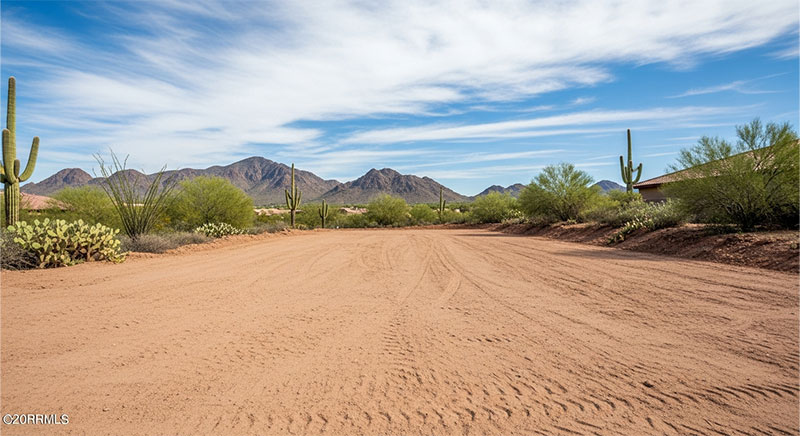
A wide dirt road lined with desert vegetation, including cacti and shrubs, under a partly cloudy sky with mountains in the background.

The DirtFX Difference

  • Transparent pricing with detailed written estimates
  • No hidden fees or surprise charges
  • Direct communication with project managers
  • Before/after photos and documentation
  • Professional cleanup leaving site ready

Serving Mesa, all East Valley Communities & North to Payson.

DirtFX proudly provides demolition services throughout Mesa, Gilbert, Chandler, Tempe, Queen Creek, and surrounding East Valley communities.
Our Mesa location offers quick response times and deep familiarity with local neighborhoods, building codes, and permitting requirements.

Mesa

Gilbert

Chandler

Tempe

Queen Creek

Maricopa County