Land Clearing & Lot Preparation Paradise Valley, Scottsdale, Arcadia, Fountain Hills & Payson
Professional Desert Land Clearing for Residential Lots, Commercial Parcels, & Multi-Acre Properties
Professional Desert Land Clearing Services for Paradise Valley, Scottsdale, Arcadia, Fountain Hills & Payson Properties
DirtFX provides comprehensive land-clearing and lot-preparation services throughout Paradise Valley, Scottsdale, Arcadia, Fountain Hills & Payson.
From residential building lots and custom home sites to multi-acre commercial parcels, our experienced crews handle every desert clearing project with specialized equipment, protected species compliance, and efficient debris recycling.
Desert Vegetation Removal & Tree Clearing
Professional removal of AZ’s native desert trees, including mesquite (velvet and honey varieties), palo verde (Arizona state tree), desert ironwood, and desert willow.
Mesquite trees develop exceptional root systems requiring excavators to expose and cut major roots before trunk removal, standard chainsaws cannot access these extensive underground networks.
Palo verde features green bark and yellow blooms, which require careful removal. Complete vegetation clearing prepares lots for construction while addressing deep root systems unique to desert flora.
Protected Cactus Removal & Relocation Services
Specialized removal of protected cactus species throughout your project requires permits from the Arizona Department of Agriculture and compliance with applicable regulations.
Saguaro cactus classified as ‘highly safeguarded’ any saguaro over the required height requires a permit, tag, and seal before removal or relocation.
Property owners must notify the Department, allowing salvage operators time to harvest plants exemptions: homeowners removing up to 5 native plants per year for landscape maintenance.
Barrel cactus, cholla cactus, prickly pear, and ocotillo are also protected. Professional handling prevents spine injuries and ensures regulatory compliance throughout the clearing process.
Brush Clearing & Fire Hazard Mitigation
Comprehensive brush clearing for fire safety, property maintenance, and site development throughout AZ.
Remove dense desert brush, including creosote bush, bursage species, and accumulated dead vegetation, creating fire hazards.
Arizona fire prevention guidelines emphasize defensible space around structures with intensive fuel reduction.
High-horsepower forestry mulchers grind brush in place, leaving a mulch cover and clearing vegetation faster than traditional methods.
Professional clearing reduces wildfire risk while preparing sites for development or improving property aesthetics and usability.
Rock & Boulder Removal with Specialized Equipment
Professional rock and boulder removal throughout AZ’s rocky desert terrain using heavy-duty specialized equipment.
Surface rock collection uses rock rakes and landscape rakes with carbide-tipped teeth to efficiently gather rocks while conditioning soil.
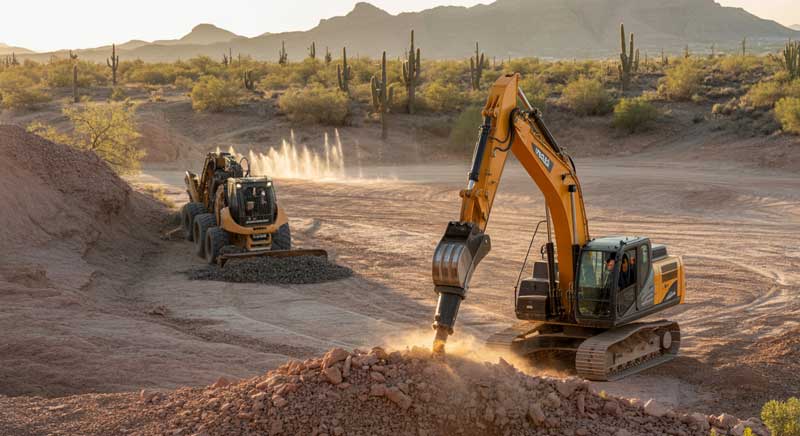
Embedded boulder extraction employs mini excavators for smaller boulders and large excavators with hydraulic breakers for massive boulders that need to be broken into manageable pieces.
Rock disposal options include hauling off-site or stockpiling for decorative landscaping use.
Specialized equipment handles AZ’s challenging rocky soil, creating smooth, construction-ready surfaces.
Caliche Excavation & Hard Soil Breaking
AZ’s notorious caliche layer, calcium carbonate cemented soil called ‘God’s concrete’ requires specialized breaking equipment unavailable for standard soil excavation.
Caliche, when dry, feels almost as hard as weak concrete, making excavation extremely difficult and time-consuming.
Breaking equipment includes hydraulic excavator breakers delivering repeated high-impact blows, carbide-tipped buckets with reinforced teeth cutting through hardpan and rock, rock bars and pry bars for manual breaking in tight areas, and rippers mounted on bulldozers tearing through caliche layers.
Professional caliche excavation addresses AZ’s unique geological challenges, preparing sites for proper foundation work and construction.
Stump Grinding, Root Removal & Grubbing
Complete stump and root removal (grubbing) to prevent regrowth and create smooth, construction-ready surfaces.
Stump grinding removes stumps below ground level, allowing backfilling and seeding of surrounding areas.
Stump plowing/excavation pushes stumps out with dozers after cutting trees, while excavators dig around root systems, exposing root tips before extraction.
Root removal methods include excavation, exposing major roots for cutting, grubbing, pulling entire root systems from the soil, and root plowing, which severs roots below the surface.
Desert tree root removal is particularly challenging, as mesquite roots can extend extremely deep, requiring extensive excavation for complete removal and preventing regrowth.
Our 10-Phase Desert Land Clearing Process
DirtFX follows a comprehensive process for desert land clearing in Paradise Valley, Scottsdale, Arcadia, Fountain Hills & Payson, ensuring compliance with protected species regulations, environmental responsibility, and construction-ready results.
From initial assessment through final cleanup, our systematic approach addresses all unique challenges of clearing desert lots.
STEP 01
Site Assessment, Planning & Protected Species Survey
1-2 days
Conduct comprehensive on-site evaluation surveying land identifying vegetation types, densities, and potential obstacles including protected species, rocks, and terrain challenges. \
Professional surveyors map existing vegetation, remnant structures, debris, and topographical features, considering local environmental laws and the impact of theclearing process.
Property assessment evaluates size, health, and root systems of trees/shrubs requiring removal, whether tree removal may impact soil stability or erosion, underground utilities or structures present, and equipment access points and limitations.
Protected species identification critical: saguaro cacti over specified height, barrel cacti, palo verde trees, mesquite trees, ironwood, and desert willow all require permits and special handling.
DirtFX provides detailed site assessments that identify clearing requirements, protected species present, permit needs, and timeline estimates, and comprehensive written proposals outlining scope, methods, timeline, and regulatory compliance procedures.
STEP 02
Permitting & Regulatory Compliance
1-6 weeks
You can secure multiple permits from different agencies before clearing begins.
Arizona Department of Agriculture Protected Native Plant Permits: notification required with advance notice, depending on acreage, to allow salvage operators time to harvest plants.
Department personnel may conduct plant surveys verifying species and quantities. Tags and seals must be firmly affixed to each protected plant before removal from the original growing site.
Permits from your city’s Building Safety Division are required for certain land modifications. Maricopa County Rule 310 Dust Control Permits are required for projects that disturb larger acreage.
DirtFX handles all permitting paperwork, agency coordination, inspection scheduling, and compliance documentation, ensuring projects proceed legally without delays or violations.
STEP 03
Site Preparation, Boundary Marking & Erosion Control
Morning of project start
After securing permits, mark boundaries and identify preservation areas.
Equipment mobilized to the site was typically completed the morning of project start.
Property marking: identify boundaries, preserved features, and hazards using visible markers/stakes/flags; establish clear boundary delineation between native and stripped areas; maintain clear boundary delineation between native and stripped areas at all times; protect preserved vegetation and landscape features with temporary fencing if needed.
Install erosion control measures before clearing begins: silt fencing around the site perimeter to prevent sediment from leaving the property during and after clearing; erosion control blankets on slopes vulnerable to washout; mulch or gravel on access roads to reduce dust and erosion; and temporary berms or swales to direct stormwater away from cleared areas.
Site preparation ensures that clearing proceeds systematically within defined boundaries, protecting surrounding areas and complying with environmental regulations.
STEP 04
Protected Species Removal, Tagging & Salvage Coordination
Variable timeline
Professional crews carefully identify and handle protected native species, ensuring compliance and minimal environmental impact.
Tags and seals must be firmly affixed to each protected plant before removal from the original growing site, remaining until permanently replanted.
The Arizona Department of Agriculture posts copies of destruction notices in public areas and mails notices to registered salvage operators who may wish to harvest plants before clearing, allowing time for salvage operators to access the property and remove plants they want to preserve.
Saguaro cactus removal requires specialized equipment and techniques: cranes or excavators lift and transport large specimens; root balls are carefully excavated, preserving lateral root systems; and plants are wrapped in protective materials to prevent spines from injuring workers and to prevent transport damage.
Professional protected species handling ensures regulatory compliance, worker safety, and plant preservation whenever possible through salvage operator coordination.
STEP 05
Vegetation Removal with Specialized Equipment
1-3 days typical
Vegetation clearing proceeds systematically using equipment matched to vegetation types.
Desert trees: chainsaws section trees into manageable sizes for removal or sale; bulldozers or excavators push over large trees; professional logging companies are hired for dense conditions; excavators expose and cut mesquite’s major roots before removing trunks.
Brush and shrubs: high-horsepower forestry mulchers grind brush in place, leaving a mulch cover and clearing vegetation faster than traditional methods while causing less soil disturbance.
Brush mowers cut standing vegetation, which is then piled for disposal or burning (where permitted). Excavators with grapples grab and pile brush for hauling or processing.
Clearing patterns maximize efficiency: work systematically from one edge across the property, avoiding equipment from crossing already-cleared areas; push vegetation into windrows or piles for easier loading and hauling; and maintain clear pathways for equipment movement throughout the site.
Professional clearing removes all above-ground vegetation, preparing sites for the next phases.
STEP 06
Stump & Root Removal, Rock Clearing
1-2 days typical
Grubbing removes tree stumps, roots, and underground obstructions using heavy machinery, ensuring complete vegetation removal and preventing regrowth.
Stump grinding exposes roots and breaks them up with root saws; grinds stumps below ground level; roots gradually decay and become part of the soil over time.
Stump plowing/excavation: takes trees down to manageable stumps, then pushes them out with dozers; excavators dig around root systems, exposing tips before extraction.
Root removal methods: excavation exposes major roots for cutting with chainsaws or hydraulic shears; grubbing pulls entire root systems from the soil, leaving large holes requiring backfilling; root plowing severs roots below the surface, allowing stumps to be removed without extensive digging.
Rock clearing: rock rakes gather surface rocks; excavators remove embedded boulders; hydraulic breakers fracture large rocks into manageable pieces; rocks are hauled off-site or stockpiled for landscaping.
Professional stump and rock removal creates smooth surfaces ready for grading and construction.
STEP 07
Caliche Breaking & Hard Soil Penetration
This variable can add significantly to the standard excavation time.
After vegetation and rock removal, address AZ’s notorious caliche layer underneath, calcium carbonate-cemented soil that forms a concrete-like substance.
Caliche challenges: when dry, it feels almost as hard as weak concrete, making excavation extremely difficult; standard machinery struggles to cut through hardpan soils; excavation proceeds gradually as material breaks up; variable thickness and quality across sites create unpredictable conditions.
Breaking equipment: hydraulic excavator breakers deliver repeated high-impact blows, fracturing caliche into removable pieces, carbide-tipped buckets with reinforced teeth designed for abrasive materials cut through hardpan more effectively than standard buckets.
Rock bars and pry bars manually break caliche in areas too tight for large equipment. Rippers mounted on bulldozers tear through caliche layers before excavation.
Caliche excavation is one of the most challenging aspects of AZ land clearing, requiring patience, specialized equipment, and experienced operators who understand how to work with this unique geological formation.
STEP 08
Topsoil Stripping, Preservation & Stockpiling
1 day typical
Professional operations strip and preserve topsoil for reuse after construction, maximizing soil resource efficiency.
Stripping methods: topsoil stripped only from areas disturbed by excavation, filling, road building, or equipment compaction; stripping progresses from thin soil areas to deeper regions, reducing contamination potential; work downhill when possible, storing topsoil downslope or off-site to prevent sediment deposition on stripped areas.
Stockpiling best practices: stockpile topsoil separately from subsoil to avoid mixing and degradation; locate stockpiles away from drainage areas and watercourses to prevent erosion and sediment runoff; protect stockpiles with erosion control measures, including silt fencing and mulch cover; seed stockpiles if they will remain in place long-term to prevent erosion and weed establishment.
Preserved topsoil is a valuable resource that contains organic matter, nutrients, and beneficial soil organisms, all of which are essential for establishing vegetation after construction is complete.
Professional topsoil management ensures this resource remains available for final landscaping and site restoration.
STEP 09
Rough Grading, Leveling & Drainage Establishment
1-2 days typical
After clearing, rough grading establishes proper site elevations and drainage patterns, preparing lots for construction.
Grading goals: create positive drainage away from building areas to prevent water accumulation near foundations; establish proper slopes meeting building codes and engineering specifications; remove high spots and fill low areas to create relatively level building pads; compact disturbed soils to the specified density to prevent future settlement.
Drainage establishment: install swales or berms directing stormwater to appropriate discharge points; ensure site drains toward streets, drainage easements, or retention areas, as required by local regulations; prevent erosion on slopes with appropriate grade breaks and erosion control measures; coordinate drainage with adjacent properties to avoid water discharge onto neighboring lands.
Equipment: bulldozers push and spread soil to establish rough grades; motor graders fine-tune slopes and drainage patterns; excavators dig drainage swales and shape terrain features; compactors ensure proper soil density, meeting engineering requirements.
Professional rough grading transforms cleared lots into construction-ready sites with adequate drainage and stable soils.
STEP 10
Debris Removal, Recycling & Site Cleanup
1-2 days typical
The final phase removes all clearing debris, leaving clean sites ready for the next phases.
Vegetation debris disposal: wood chips from mulched vegetation spread on-site as erosion control and soil amendment, marketable timber sold to lumber yards or firewood processors, non-marketable wood and brush hauled to green waste facilities or burned (where permitted), stumps and large roots hauled to facilities processing them into mulch or compost.
Rock and soil disposal: excess soil and caliche hauled to approved disposal sites or used for fill on other projects, rocks and boulders hauled off-site or stockpiled for future decorative landscaping use, recyclable materials separated and sent to appropriate facilities.
Site cleanup: remove all equipment, temporary fencing, and erosion control measures no longer needed; fill equipment ruts and tracks with soil, then compact; rake or drag the site, removing debris and creating a uniform surface; conduct a final site inspection, ensuring all clearing objectives are met and the site is ready for construction.
Professional cleanup transforms raw, cleared land into organized, construction-ready lots that meet all regulatory requirements and are prepared for building permit applications and foundation work.
What Makes Desert Land Clearing in AZ Unique?
Factors That Affect Land Clearing Costs
Desert land-clearing costs vary significantly depending on AZ property conditions and project complexity.
While DirtFX provides detailed written estimates after on-site lot assessments, understanding the key factors helps property owners and developers plan project budgets effectively.
Every clearing project is unique, and we believe in transparent communication about the factors that influence scope and timeline.
Lot Size & Acreage
Property size significantly affects the scope and duration of land clearing.
Larger parcels require more equipment time, labor hours, and debris disposal capacity than smaller residential lots.
Multi-acre commercial properties require extensive clearing, while single residential building lots are completed more quickly.
Acreage directly correlates to project scale, affecting overall scope from initial assessment through final cleanup.
Site size determines the types of equipment deployed and the crew size requirements.
Vegetation Density & Type
Desert vegetation varies dramatically across AZ properties, affecting the complexity of clearing.
Dense mesquite groves with extensive root systems require significantly more excavation work than sparse creosote coverage.
Mature Palo Verde trees demand different removal techniques than young shrubs.
Properties with heavy brush accumulation need intensive clearing, while lightly vegetated lots clear faster, native plant species, sizes, and densities all impact equipment selection and clearing duration.
Protected Species Quantity & Permitting
The number and size of protected plants requiring Arizona Department of Agriculture permits affect project timelines and administrative requirements.
Properties with numerous large saguaro cacti require extensive permit processing and potential coordination with a salvage operator.
Sites with many protected palo verde, mesquite, or ironwood trees require additional documentation.
Permit processing times vary based on property acreage and notification requirements.
Protected species identification, tagging, and coordination represent significant project components beyond physical clearing work.
Rock, Boulder & Caliche Conditions
AZ’s geological challenges dramatically impact clearing difficulty and duration.
Properties with extensive surface rock coverage require additional collection and disposal work.
Sites with large embedded boulders need hydraulic breakers and specialized extraction equipment.
Thick caliche layers underneath vegetation demand carbide-tipped excavator buckets and extended breaking time.
Caliche depth, hardness, and extent vary significantly across properties, some sites have minimal caliche, while others feature extensive deposits that require substantial additional excavation effort beyond vegetation removal.
Equipment Access & Site Constraints
Property accessibility affects equipment deployment and operational efficiency.
Sites with wide street access allow large equipment to enter, while properties with narrow access points require smaller machines that work less efficiently.
Terrain slope, neighboring structures, overhead power lines, and existing landscaping requiring protection all constrain equipment operation.
Urban lots with adjacent buildings need careful equipment operation, while open rural parcels allow unrestricted clearing.
Access limitations may require equipment to be mobilized from multiple entry points or manual clearing in restricted areas.
Project Timeline & Seasonal Considerations
Clearing timeline requirements affects scheduling and resource allocation.
Rush projects with specific deadlines may require additional crews or extended hours.
Seasonal factors impact work scheduling monsoon season requires erosion-control measures and weather contingencies, while extreme summer heat necessitates early-morning schedules and heat-safety protocols.
Agricultural burning restrictions during certain months affect disposal options.
Winter months offer moderate temperatures but shorter daylight hours.
Timeline flexibility allows efficient scheduling, while tight deadlines require intensive resource deployment.
Debris Volume & Disposal Requirements
Volume and type of clearing debris affect hauling and disposal logistics.
Properties with extensive vegetation generate substantial wood chip, brush, and stump debris requiring multiple disposal trips.
Rock-covered sites produce heavy boulder and gravel loads.
Marketable timber may offset disposal fees through sale, while non-marketable vegetation requires hauling to green waste facilities.
Distance to approved disposal sites affects transportation time and fuel consumption.
Debris recycling options vary by material type and local facility capabilities.
Regulatory Compliance & Dust Control
Maricopa County Rule 310 dust control requirements apply to clearing operations, particularly on larger properties.
Dust suppression equipment, water trucks, and monitoring procedures ensure compliance during clearing work.
Projects disturbing larger acreage require formal dust control permits and compliance plans.
Environmental protection measures, including erosion control, stormwater management, and sediment retention, are included as project components.
Regulatory compliance is an essential project element that ensures legal operations throughout AZ’s land-clearing work.
Specialized Equipment & Techniques Required
Desert clearing often requires specialized equipment beyond standard landscaping tools.
High-horsepower forestry mulchers, carbide-tipped excavator buckets, hydraulic breakers, rock rakes, and caliche-specific attachments represent specialized investments.
Mesquite root excavation needs heavy-duty equipment to access deep root systems.
Handling protected species requires trained personnel and appropriate rigging equipment.
Equipment specialization affects operational capabilities and efficiency.
Properties requiring multiple specialized equipment types involve more complex logistics than those cleared with standard machinery.
Special Requirements & Site Challenges
Unique site conditions create project variations.
Properties with remnant structures, old foundations, or buried debris require additional demolition and removal work.
Sites in HOA communities may need architectural review approvals and compliance with specific clearing standards.
Slopes requiring terracing or retention walls add grading complexity.
Underground utilities needing protection during clearing operations require careful coordination.
Historic properties or environmentally sensitive areas may have additional restrictions.
Fire hazard mitigation, creating defensible space, involves specific vegetation removal patterns and spacing requirements.
Each site presents unique challenges affecting project scope and approach.
Transparent Pricing
DirtFX provides detailed written estimates after a thorough on-site assessment of your specific conditions.
We evaluate all factors affecting your project and clearly explain our pricing.
Every AZ property and construction project is unique.
Please get in touch with us at 480-571-1046 for accurate project-specific pricing.
Land Clearing Questions AZ Property Owners Ask
Get answers to common questions about desert land clearing and lot preparation in AZ. From protected species permits and caliche challenges to equipment access and environmental compliance.
Still have questions about your demolition project?
Why AZ Property Owners & Contractors Choose DirtFX Excavation
Professional Concrete Demolition services backed by experience, expertise, and local knowledge
10+ Years AZ-Specific Experience
Decade of demolition expertise serving Paradise Valley, Scottsdale, Arcadia, Fountain Hills & Payson property owners. We understand local codes, soil conditions, and permit requirements.
Fully Licensed & Insured
ROC licensed contractor with comprehensive general liability and workers compensation insurance protecting your property and our crews.
Specialized Caliche Equipment
Heavy-duty hydraulic breakers designed specifically for Arizona’s hard caliche foundations. We have the right tools for AZ’s unique geology.
Complete Permit Handling
We manage all AZ Building Safety permits, HOA approvals, and inspection requirements. No paperwork hassles for you.
Transparent Communication
No surprises, no hidden fees. Detailed written estimates with all costs itemized, regular project updates with photos, and direct access to project managers.
OSHA-Trained Crews
Safety-certified operators with extensive demolition training. Every crew member follows strict OSHA safety protocols on every project.
Reliable Timeline Delivery
We provide realistic timelines and stick to them. No surprise delays or extended projects. Most residential demos are completed in one week.
Environmentally Responsible
We recycle metal, concrete, and wood whenever possible. Proper disposal at licensed facilities with documentation provided.
Local Mesa Company
Based in Mesa at 7303 S. Hawes Road. We’re your neighbors, invested in our community and reputation throughout the East Valley.
The DirtFX Difference
Serving Paradise Valley, Scottsdale, Arcadia, Fountain Hills & Payson Communities.
Our Mesa location offers quick response times and deep familiarity with local neighborhoods, building codes, and permitting requirements.
Mesa
Dobson Ranch, Eastmark, Red Mountain Ranch, Las Sendas, Superstition Springs, Alta Mesa, Sunland Village
Gilbert
Val Vista Lakes, Coronado, Greenfield Lakes, Morrison Ranch, Agritopia, Heritage District
Chandler
Ocotillo, Sun Lakes, Fulton Ranch, Cooper Commons, Markwood, Pecos Ranch
Tempe
Corona del Sol, Warner Ranch, South Tempe, Lakewood, Carredas, College District
Queen Creek
Montelena, San Tan Heights, Cortina, Bella Vista, Province, Pecan Creek
Maricopa County
Free estimates throughout Maricopa County & north to Payson too.