House Pad Excavation in Scottsdale, AZ
Engineered Building Pads for Custom Home Construction
Benched into decomposed granite up north, rebuilt from old fill down south.
Surgical over-excavation within NAOS and setback limits.
Compacted and certified for your builder’s foundation inspection.
Licensed, Bonded, and Insured (ROC #358362 & #355605)
Serving the Scottsdale area since 2014
DirtFX builds engineered house pads across Scottsdale, AZ
A house pad is a compacted and certified platform your custom home is built on.
The job changes completely from one end of the city to the other.
In north Scottsdale, a pad is cut and benched into decomposed granite and rock on a sloped desert lot, with over-excavation kept surgical inside the limits of NAOS and boulder setbacks.
In south and central Scottsdale, a pad usually means digging out decades of undocumented fill and rebuilding to a stable, certified surface. Either way, we build to your soils report and leave the lot pad-ready for your builder’s foundation inspection.
Why Scottsdale Lots Need a Properly Engineered Pad
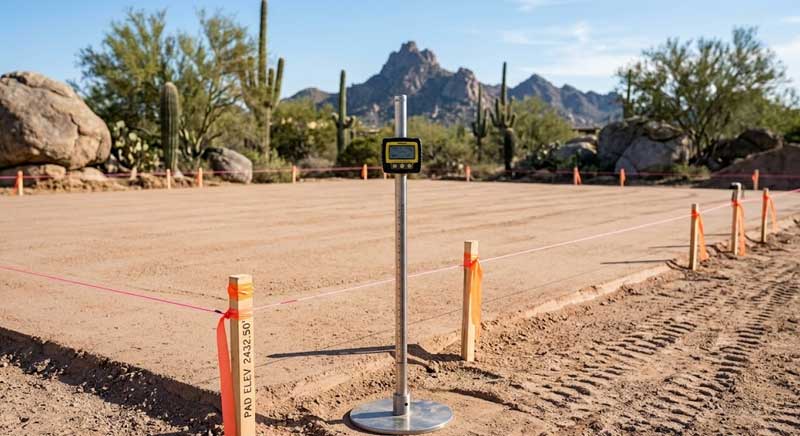
A house pad is not graded dirt. It is the load-bearing platform your foundation sits on, and on a Scottsdale lot there are two very different reasons it has to be engineered.
North Scottsdale: thin soil over rock and slope. Lots in Troon, Desert Mountain, Pinnacle Peak, DC Ranch, and the surrounding desert sit on shallow soil over decomposed granite and bedrock, often on a grade, frequently with boulders in the footprint. You cannot just level a slope and build. The pad has to be cut and benched into competent rock and built back up with engineered fill, so the foundation bears evenly instead of settling on loose colluvium or fractured surface material.
South and central Scottsdale: decades of old fill. Older lots in Old Town, McCormick Ranch, and the central corridors carry urban fill placed over decades of development, sometimes undocumented, sometimes mixed with buried debris, sometimes over expansive clay or collapsible soils. Build a foundation on uncontrolled fill and it settles unevenly. The pad has to be over-excavated and rebuilt to a known, compacted standard.
In both cases the deliverable is the same: an engineered pad, compacted to your soils report and certified for inspection. The path to get there is what differs.
Why Scottsdale Lots Need a Properly Engineered Pad
This is what sets a north Scottsdale pad apart, and it is where many contractors get it wrong. Two things push in the same direction at once.
NAOS, desert washes, and the 20-foot boulder setbacks cap how wide you are allowed to disturb the lot. At the same time, the shallow soil over rock means you do not want to disturb wide, because every lateral foot is more rock to cut for no structural gain.
So the right pad goes deep where it counts, inside the structural footprint, and stays tight everywhere else. We call it surgical over-excavation: vertical where the foundation needs it, minimal beyond the building envelope.
On sloped lots, that means benching and stepped pads. We cut a level bench into the decomposed granite or bedrock, step the cuts and fills down the grade, and use retaining walls to keep fill heights reasonable rather than pushing a huge engineered slope.
Boulders in the footprint are removed, reset, or incorporated into the design, and significant outcrops and the NAOS around the pad are preserved. The result is a stable, certified pad that respects both the rock and the rules.
How Dirtfx Builds An Engineered House Pad
Over-Excavation
We remove the unsuitable material: loose colluvium, collapsible or organic soil up north, undocumented or uncontrolled fill down south. How deep depends on what the soils report and the rock line call for, not a fixed number.
Bench and Scarify
On northern rock lots we cut a level bench into the decomposed granite or bedrock and scarify the surface so engineered fill bonds to it.
On southern lots, we scarify competent native soil or recompact existing fill where the geotech allows.
Select Fill in Lifts
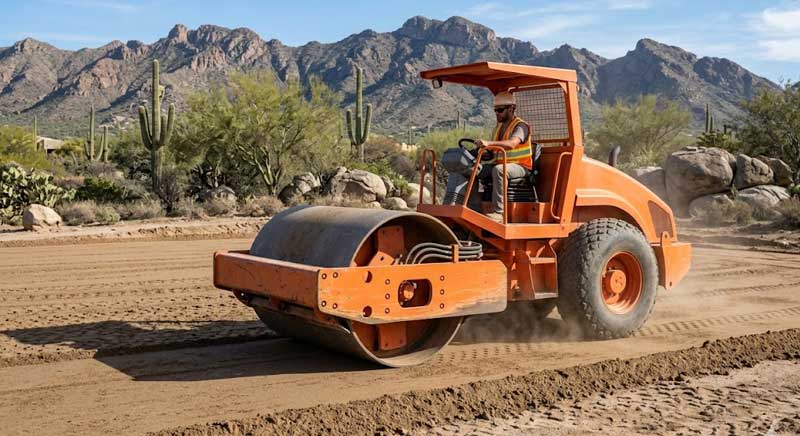
We build the pad back up with engineered select fill placed in controlled lifts of 6 to 12 inches, not dumped all at once, so it compacts thoroughly through the full depth.
Moisture Conditioning
Each lift is moisture-conditioned to near optimum before compaction. In Arizona heat fill dries fast, and dry fill will not reach density, so this step matters.
Compaction to Specification
We compact each lift to the density your soils report requires, typically in the range of 90 to 95 percent of maximum dry density.
Retaining and Benching for Slope
Where grade demands it, we set retaining and step the pad so fill heights stay sound and the disturbed area stays within limits.
Grade, Drain, and Confine
We grade to plan elevation with proper drainage and keep the work inside the building envelope so NAOS stays untouched.
Compaction Testing and Certification
The pad is density-tested and certified, so you have the documentation your structural engineer and the city need before the foundation goes in. We coordinate this with the project geotechnical engineer.
Building on Old Fill: South and Central Scottsdale
South Scottsdale pads look easier because the lots are flat, but the ground hides its own problems. These older, built-out areas carry decades of fill, and what is under your lot is not always documented.
Undocumented fill. Fill placed during past development may not have been engineered or tested. We over-excavate it to competent native soil or to the depth the geotech specifies, then rebuild with compacted select fill so the pad has a known bearing value.
Expansive clays. Lower-lying parts of the valley floor can hold expansive clay that swells and shrinks with moisture. The fix is to remove and replace it with moisture-conditioned, non-expansive structural fill, or to deepen the foundation, a call your engineer makes. We provide the over-excavation and replacement to spec.
Collapsible soils. Some northeast-valley foothill soils look firm but settle sharply when they get wet. These call for deeper over-excavation and careful moisture conditioning so the pad does not drop after the first heavy season.
Caliche. Weak or discontinuous caliche in the bearing zone gets removed as soft rock and replaced with compacted fill. Thick, competent caliche can serve as bearing but complicates utilities and drainage, which we plan around.
The common thread: on a south Scottsdale lot, a soils report is not a formality. It tells us what is really down there, and we build the pad to answer it.
Permits and Site Constraints
Native Plant Permit before the grading permit. If protected plants fall within your pad footprint, the native plant permit and program take precedence over grading. We handle that as part of the site work or alongside our land clearing scope.
Dust control before disturbance. A Maricopa County dust control permit must be in hand before ground disturbance of one tenth of an acre or more.
Mass grading is prohibited on large ESL lots. Inside the ESL overlay, large residential lots must be graded individually per building permit, not mass-graded across the parcel. We grade lot by lot, to the plan.
NAOS confinement and boulder setbacks. Work stays inside the building envelope, out of NAOS, and at least 20 feet off protected boulder features.
At-risk grading to start sooner. Scottsdale allows rough grading to begin before full plan approval under set conditions, with an owner risk letter. Where it fits, this can move your project forward weeks earlier. We will tell you when it makes sense.
HOA architectural review. In north Scottsdale communities, grading needs written architectural review approval before city permit work begins. We plan around those timelines.
What Affects Your House Pad Cost In Scottsdale
Every lot is different. These factors drive the quote:
Rock and over-excavation depth. How much decomposed granite or bedrock has to be cut, and how deep the unsuitable material runs, is the biggest variable up north.
Slope and benching. Steeper lots need more cut, benching, and retaining, which adds time and material.
Fill volume. Whether the lot balances cut and fill or needs imported select fill, and how much.
Soil conditions down south. Undocumented fill, expansive clay, or collapsible soil that has to be removed and replaced adds scope.
NAOS and setback limits. Tighter envelopes change how the work is staged and how much can be disturbed.
Compaction specification. Higher density requirements mean more passes and more testing.
Access and staging. Lot access, slope, and room to stage equipment and stockpile fill affect efficiency.
Permits and HOA review. City, county, native plant, and architectural review coordination.
We provide a detailed written quote after an on-site assessment and a look at your soils report.
Your House Pad Timeline
Every pad follows a structured process. Timelines vary with permit processing, fill import, and weather.
Pad fieldwork is usually days to a couple of weeks, depending on rock, slope, and fill volume. On north lots, the approval runway is the longer part, so starting permits early keeps your build on schedule.
PHASE 01
Assessment and Planning
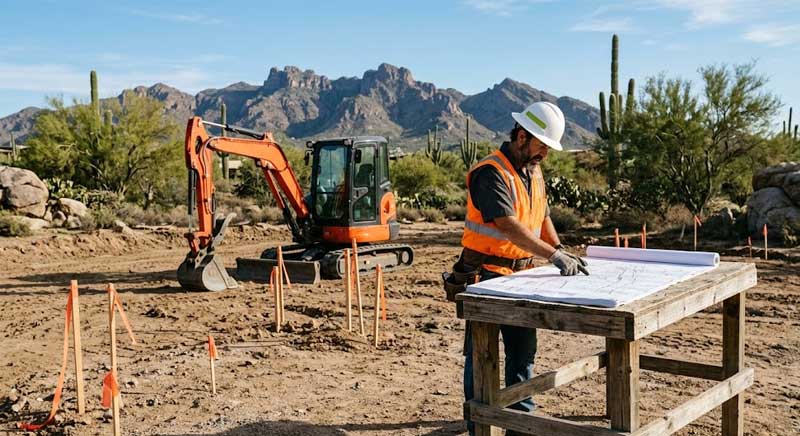
Free on-site evaluation. We review your soils report and grading plan, check rock and slope, confirm NAOS and setback limits, and provide a detailed written quote.
PHASE 02
Permits and Approvals
Grading permit (with native plant permit first where required), county dust permit, and HOA architectural review where it applies. We flag whether at-risk grading can start the work earlier.
PHASE 03
Over-Excavation and Benching
We remove unsuitable material and, on slopes, bench and cut into rock, setting retaining as needed.
PHASE 04
Fill, Compaction, and Certification
We build the pad in moisture-conditioned lifts, compact to your soils report spec, grade to plan elevation with drainage, and provide the compaction documentation your builder and the city need for the foundation inspection.
Frequently Asked Questions About
House Pad Excavation In Scottsdale
Still have questions about your house pad project?
Why Scottsdale Builders and
Homeowners Choose DirtFX
Desert Rock Experience. We cut and bench pads into decomposed granite and bedrock and build them back to spec, the core skill north Scottsdale lots demand.
Surgical, Compliant Earthwork. We over-excavate where the foundation needs it and keep disturbance inside NAOS and setback limits, so the pad is sound and the lot stays compliant.
Engineered and Certified. We compact to your soils report and provide the density documentation your builder and the city need.
Old-Fill Know-How. Down south we find and fix undocumented fill, expansive clay, and collapsible soils instead of building over them.
Builder Coordination. We grade to spec, align with your construction timeline, and hand off a pad-ready, certified site.
Owned Equipment Fleet. Rock-capable excavators, loaders, and compaction equipment, available when your project needs them.