Land Clearing & Native Plant Work in Scottsdale, AZ
Raw Desert Lots Cleared for Custom Builds.
Teardown Sites Cleared for the Rebuild.
Native plant permits and protected-plant salvage handled.
ESL and NAOS compliance are built into the plan.
Cleared to grade and ready for your builder.
ROC: 358362 & 355605
Serving the Scottsdale area since 2014
DirtFX clears residential lots across Scottsdale, from raw Sonoran Desert parcels in the north to teardown sites in Old Town and central Scottsdale. In Scottsdale, clearing a lot is rarely a simple scrape.
Most northern Scottsdale lots sit within the city’s Environmentally Sensitive Lands overlay, where a Native Plant Permit must be approved before the grading permit, protected saguaros and trees must be salvaged rather than bulldozed, and a share of the lot must remain untouched as Natural Area Open Space.
We handle that full process and leave your site cleared to grade and ready for your builder.
North and South Scottsdale Are Two Different Clearing Jobs
Scottsdale splits cleanly into two markets, and what works in one behaves nothing like what works in the other. Knowing which one you have is the first thing that matters.
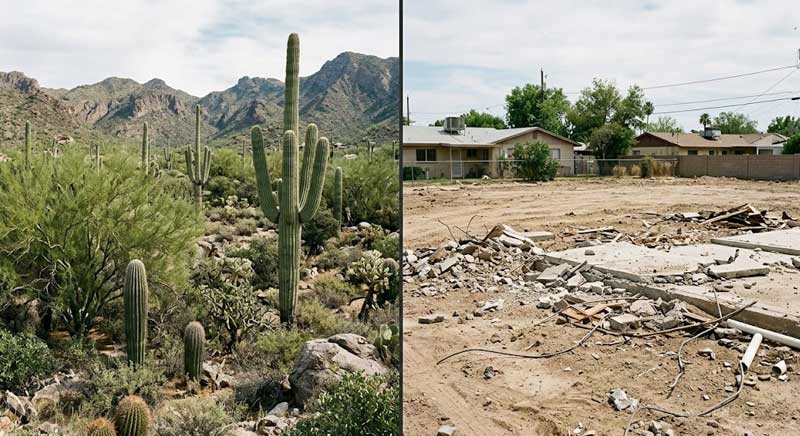
North Scottsdale is a regulated desert clearing. Troon, Desert Mountain, Pinnacle Peak, DC Ranch, Silverleaf, and the surrounding desert are raw-land and first-build markets. The lots are dense Sonoran Desert on thin soil over decomposed granite and rock, often on slopes, almost always inside the ESL overlay. Here, clearing is a preservation-and-corridor job, not a scrape. You open only what the approved plan allows, salvage the protected plants, work around boulders and NAOS, and leave the rest of the desert intact.
South and central Scottsdale is teardown-clearing. Old Town, McCormick Ranch, Park Scottsdale, and the Arcadia border are aging 1950s- to 1980s-era homes on flatter alluvial soil with decades of urban fill. Here, clearing usually follows demolition: remove the old structure, hardscape, and landscaping, address buried fill and utilities, and grade the lot for the rebuild. Lighter regulation, faster timelines, closer to a standard clear-and-grade.
We work both ends of the city with the right approach and equipment for each. The rest of this page covers the northern desert process in detail, with notes on where the southern teardown process differs.
What We Clear and Prepare
Native Plant Inventory and Permitting
Before anything is cleared on a north Scottsdale lot, the protected plants have to be identified and permitted.
We inventory the saguaros, ironwood, palo verde, mesquite, and other protected species on the property, prepare the native plant program the city requires, and obtain the Native Plant Permit.
That permit comes before the grading permit, so this is the first real step, not an afterthought.
Protected Plant Salvage and Relocation
Scottsdale’s ordinance follows a salvage hierarchy: leave protected plants in place where possible, salvage and replant them on-site when they must move, and remove them only when relocation is demonstrably impossible.
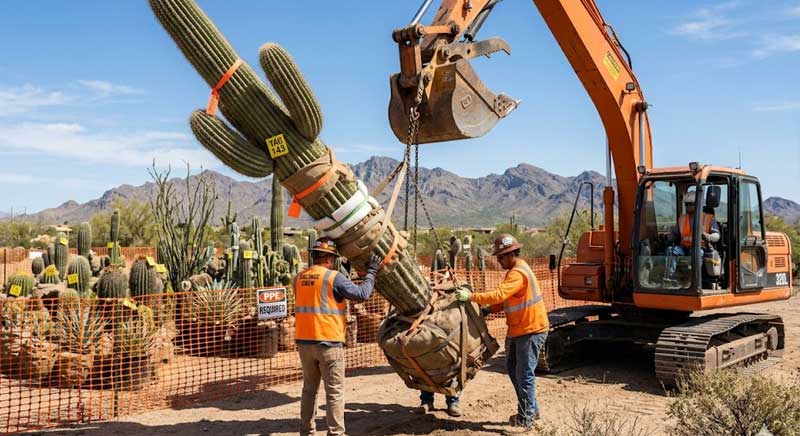
We tag and salvage protected plants, set them in an on-site holding nursery when needed, and coordinate the city’s pre-salvage inspection.
Salvaged plants are tracked, and we plan the work to maintain high survival.
Brush and Vegetation Clearing
Once the protected plants are handled, we clear the non-protected brush, scrub, and vegetation from the building corridor: the pad footprint, driveway, and utility runs.
On desert lots that means opening only the area the plan allows and leaving the rest in its natural state.
Rock, Boulder, and Decomposed Granite Management
In north Scottsdale, clearing is as much about rock management as it is about vegetation removal.
Lots carry boulder fields, rock shelves, and shallow soil over decomposed granite.
We manage boulders within the work area, saw-cut or break rock where a corridor requires it, and on many lots preserve significant outcrops as landscape features, which both the design and the ESL rules often call for.
Hardscape and Structure Removal (South and Central)
On teardown lots, we clear what the old property left behind: concrete patios, driveways, block and retaining walls, outbuildings, sheds, fencing, and overgrown landscaping.
We demolish and haul it, recycling concrete where possible, and clear the site to bare graded dirt.
Rough Grading to Builder Spec
After clearing, we rough-grade the cleared area to your builder’s and civil engineer’s specifications: establish elevation, cut high spots, fill low areas, set the drainage slope, and compact for a stable surface.
Your general contractor handles final grading and the construction grading permit. We coordinate specs, elevations, and drainage with them before we start, so they get the right starting point.
What Makes Scottsdale Land Clearing Different
The Native Plant Ordinance Comes First
Scottsdale’s Native Plant Ordinance applies city-wide and protects saguaros, ironwood, both palo verde species, mesquite, desert willow, and other desert plants above set sizes (trees at four-inch caliper, cacti at three feet tall).
A Native Plant Permit and approved program must be in place before clearing or grading begins. Clear a protected plant without it, and you are looking at violations and stop-work orders.
We handle the program and permit so the project starts clean.
ESL and NAOS Limit What You Can Touch
Most north Scottsdale lots sit in the Environmentally Sensitive Lands overlay, which covers roughly two-thirds of the city north and east of the CAP canal.
Within it, a percentage of each lot must be permanently preserved as Natural Area Open Space, where no clearing or grading is permitted. The steeper the lot, the higher that percentage climbs.
We clear to the building envelope and keep equipment, staging, and spoil out of NAOS so the lot stays compliant.
North vs South Soil and Terrain
North lots are thin soil over decomposed granite and bedrock, with boulders and slopes that slow clearing and demand rock-capable equipment.
South and central lots are flatter alluvial soil with decades of urban fill and buried debris, plus caliche a few feet down.
We assess the ground on every site visit and bring the right approach.
Hillside and Slope Clearing
On hillside and steep upper-desert lots, we clear selectively, opening corridors for the pad, driveway, and utilities while leaving natural vegetation and rock in the NAOS.
Slope work often calls for temporary access ramps and smaller, more agile machines to stay within disturbance limits.
HOA Architectural Review Before the City Permit
In north Scottsdale’s master-planned communities, clearing and grading are not just new-construction items.
They require written architectural review approval before any city permit work begins.
Desert Mountain runs a four-stage review process that can add months; DC Ranch and Silverleaf require a Certificate of Covenant Compliance, and Troon treats any disturbance deeper than 12 inches as grading requiring prior approval.
We plan around these timelines instead of hitting them late.
State AZDA Notice of Intent to Clear Land
In addition to the city permit, Arizona requires advance written notice to the Department of Agriculture before clearing land with native plants: 20 days for one acre or less, 30 days for one to 40 acres, and 60 days for 40 acres or more.
We file the notice as part of the native plant package so it does not become a last-minute delay.
Our Land Clearing Process
STEP 01
Free On-Site Assessment & Quote
We walk the property with you to evaluate the scope: protected plants, landforms and slopes, ESL and NAOS status, boulders and rock, soil, access, and structures to be removed.
If you are working with a builder, we discuss their grading specs and timeline. You receive a detailed written quote, no obligation.
STEP 02
Native Plant Program, Permits, and Approvals
For north Scottsdale lots, we prepare the native plant inventory and program, file the AZDA Notice of Intent to Clear Land, coordinate the Maricopa County dust control permit, and align with your HOA’s architectural review, where applicable.
The Native Plant Permit is secured before the grading permit. This step protects your project from stop-work orders.
STEP 03
Protected Plant Salvage
We tag and salvage protected saguaros and trees per the approved program, set them in an on-site holding nursery when required, and coordinate the city’s pre-salvage inspection.
Salvaged plants are tracked through the process.
STEP 04
Clearing and Rock Management
We clear the approved building corridor: vegetation, brush, and non-protected growth removed; root systems and stumps excavated; boulders and rock managed; and significant outcrops preserved where the plan calls for it.
NAOS and protected plants are fenced and left untouched.
STEP 05
Rough Grading & Compaction
We rough-grade the cleared area to your builder’s specifications: elevation set, high spots cut, low areas filled, drainage slope established, and the surface compacted.
We provide documentation of grade and compaction for your builder’s permit package.
STEP 06
Final Walkthrough and Builder Handoff
A final walkthrough with you and your builder. The cleared area is graded, compliant, and ready for construction, with the desert and NAOS preserved around it.
We provide completion photos and documentation.
A note on timeline.
The clearing and grading fieldwork is often a matter of days to a couple of weeks, depending on lot size, rock, and slope. The approval runway is the longer part on north lots.
Between the native plant program, ESL and NAOS review, the AZDA notice, the county dust permit, and HOA architectural review, north Scottsdale preconstruction can run weeks to several months before clearing starts.
The sooner we begin the sequence, the sooner you build.
What Makes Scottsdale Land Clearing Unique
- Permit-First, Not Scrape-First: On north lots the native plant permit and program come before any clearing, and before the grading permit.
- Protected-Plant Salvage: Saguaros, ironwood, and palo verde are salvaged and relocated, not bulldozed, per the city’s salvage hierarchy.
- NAOS Preservation: A share of each ESL lot stays permanently natural, and we clear to the envelope without touching it.
- Rock and Boulder Terrain: Thin soil over decomposed granite and boulder fields makes clearing a rock-management job in the north.
- Two Markets, One Contractor: Regulated desert clearing in the north, straightforward teardown clearing in the south.
DirtFX Has Scottsdale Clearing Expertise
Cost Factors for Scottsdale Land Clearing
Every project quote depends on site-specific factors.
Here’s what affects pricing:
Every project quote depends on site-specific factors. Here is what affects pricing:
Lot size and cleared area. Larger lots and larger building envelopes mean more clearing, grading, and time.
Native plant density and salvage volume. More protected saguaros and trees mean more inventory, salvage, holding, and relocation work.
Rock and boulder volume. Decomposed granite, boulder fields, and rock shelves are slow to clear and can require saw-cutting or breaking.
Slope and hillside conditions. Steeper lots take selective clearing, access ramps, and more careful, slower work within disturbance limits.
NAOS and ESL constraints. Tighter building envelopes and preservation requirements shape how and where we can work.
HOA architectural review. Communities with formal review add coordination and lead time to the project.
Access and staging. Lot access, room to stage equipment, and proximity to neighbors affect efficiency.
Disposal volume. More vegetation, rock, and structure mean more hauling.
We provide detailed written quotes after an on-site assessment. No hidden fees. Call 480-571-1046.
Frequently Asked Questions
About Land Clearing in Scottsdale
Still have questions about your land clearing project?